
The organisations that will pull ahead aren’t the ones working hardest. They’re the ones that have finally figured out how to mine what they already have – and reinvest it. Here’s an honest look at where most organisations actually are, and what separates the ones compounding their advantage from the ones about to find their mine uncompetitive.
Every organisation is sitting on a seam of gold.
Every piece of work ever completed – every programme delivered, every product launched, every operational change managed – generated data. How long things actually took. Where budget was consumed. Which risks materialised and which were phantom. Whether the outcomes promised were the outcomes delivered. That data is extraordinarily valuable. It is, quite literally, the accumulated intelligence of everything your organisation has learned about getting things done.
Most organisations have barely scratched the surface of it.
Not because they didn’t try. The intent has always been there – the lessons learned session, the post-implementation review, the kick-off that starts by asking whether anyone has done this before. People have always known that learning from experience makes you better at it. The problem was never the intent. It was the effort. Capturing what actually happened, in real time, across every meeting and decision and risk and conversation, in a form that was comparable, retrievable, and genuinely useful for the next piece of work – that required an enormous amount of human effort. More than most organisations could sustain alongside actually delivering. So it happened partially, retrospectively, inconsistently. And then the record sat on a shelf.
As a result, most organisations have been running the same race repeatedly without learning much from each lap. Timelines estimated with optimism rather than evidence. Risks identified from memory rather than data. Problems that occurred before recurring, because nobody could access the record of their occurrence. And when something went wrong, the person who saved it got celebrated – while the question of why it nearly failed went largely unasked.
That is the mine most organisations have been working. And until recently, there wasn’t a fundamentally better way.
The equipment has changed.
AI hasn’t changed what good execution looks like. It has changed the cost of achieving it.
The meeting that used to require someone to capture, write up, and circulate minutes – and then manually update the project record – now generates a transcript automatically. Actions, decisions, risks, and learnings can be extracted in seconds. The status report that consumed Friday afternoon can be assembled from live data. The risk log that nobody maintained because maintaining it competed directly with running the work can now be updated as a byproduct of the conversations already happening. The lessons that used to be captured painfully at the end – by which point much of the richness had been lost – can now be extracted continuously throughout.
The friction that made continuous learning from execution prohibitively hard has largely disappeared.
Which means the organisations that build this capability now will get smarter with every piece of work they complete. Estimates will get sharper. Early warning systems will get more sensitive. People will spend less time on administration and more time on the judgement, relationships, and decision-making that only humans do well. Each piece of work will leave behind a richer, more accurate record than the last – feeding the next one, and the one after that.
That compounding effect is the real story. A mine that reinvests in better equipment, better surveying, better extraction – goes deeper, faster, with less risk, and surfaces more value over time. One that doesn’t, eventually finds its operation uncompetitive. Not because the seam ran out. Because someone else found a way to reach it faster.
The honest question is: how deep are you actually going?
Not how deep you think you’re going. How deep the evidence suggests you are.
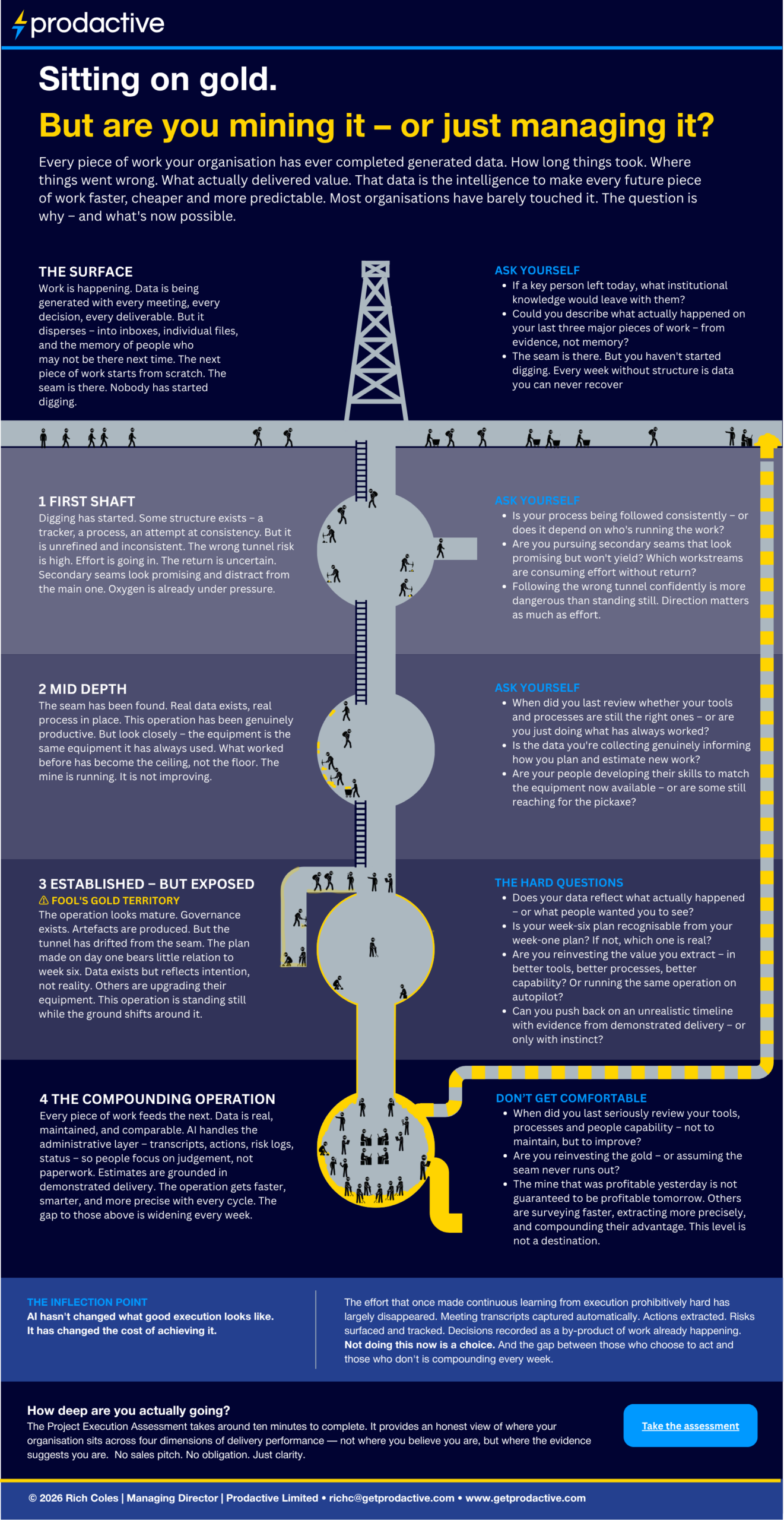
There are five positions most organisations occupy, and very few are as far down as they believe.
- At the surface, work is happening and data is being generated – but none of it is being captured in a usable form. Information disperses into email threads, individual files, and the memory of people who may not be there next time. The next piece of work starts from scratch. The seam is there. Nobody has started digging.
- In the first shaft, digging has begun. Some structure exists – a tracker, a process, an attempt at consistency. But it is inconsistent, unrefined, and at high risk of following the wrong tunnel. Effort is going in. The return is uncertain. This is where many organisations stall – not because they lack commitment, but because they haven’t yet found the seam, and the oxygen supply is already under pressure.
- At mid depth, the seam has been found. Real data exists. A genuine process is in place. This operation has been productive, and by historical standards it looks mature. But the equipment is the same equipment it has always used. What worked before has become the ceiling rather than the floor. The mine is running – but it is not improving. And mines that stop improving don’t stay competitive.
- The established but exposed position is the most dangerous one to be in – and the hardest to recognise from the inside. The operation is efficient by its own historical standards. Governance exists. Artefacts are produced. The organisation believes it has a data discipline. But look more closely and the plan made on day one bears little relation to what actually happened by week six. The tracker gets updated, but in a way that loses what changed and why. The data looks structured but it reflects intention, not reality. It is, in the language of the trade, fool’s gold. And because it looks like gold, nobody is questioning whether the mining operation needs to change. Meanwhile, others are going deeper, faster, with better equipment.
- The compounding operation looks different in one specific way: it treats every piece of work as an investment in the next one. The data captured is real – maintained, accurate, and genuinely comparable across work. It is being refined into intelligence: sharper estimates, earlier identification of risk, the ability to push back on unrealistic timelines with evidence from demonstrated delivery rather than instinct. The equipment – the tools, the processes, the people operating them – is continuously reviewed and improved. AI is doing the administrative work. People are doing the human work. And the gap between this organisation and the ones above it is widening every week.
The oxygen question.
There is something the mining metaphor captures that purely operational frameworks tend to miss. You cannot keep people underground without the conditions that keep them alive.
The teams grinding through complex programmes on effort and heroics alone are working without adequate oxygen. They are not failing because they lack commitment – they are working extraordinarily hard, often in conditions that are genuinely unsustainable. Better structure and better tools are not about doing more with fewer people. They are about creating an environment where people can work at depth without burning out. AI handling the administrative layer is not efficiency theatre. It is pumping oxygen into the mine.
The question nobody wants to answer honestly.
Every organisation reading this will have a sense of where they are. Most will place themselves one level higher than the evidence warrants.
The most useful thing this piece can do is make that harder to do.
If your last ten significant pieces of work don’t have an accurate record of what actually happened – not what was planned, but what happened – you are not at mid depth. If your estimates for new work are not meaningfully informed by the actual duration and cost of comparable past work, you are not at mid depth. If your people are spending significant time each week on administrative tasks that AI could handle, you are not at the compounding level. And if you haven’t seriously reviewed your tools, processes, and people capability in the last twelve months with the question “is this still the right equipment for where we’re trying to get to?” – you are not as deep as you think.
That is not a criticism. Almost every organisation could go deeper. The question is whether you’re going to.
Where to start.
If you are at the surface or in the first shaft, the priority is not technology. It is foundation. Consistent structure, clear taxonomy, a way of capturing what actually happens rather than what was planned. Even without internal historical data, there is external evidence to draw on – benchmarks, patterns from comparable organisations, AI that can inform how you plan and what to watch for from day one. You are not starting from nothing. But you need to start.
If you are at mid depth or in the established but exposed position, the priority is honest assessment. Not of your process – of your data. Does it reflect reality? Is your plan on week six a genuine picture of where you are, or a managed version of it? Are you learning anything from completed work that is measurably changing how you approach new work? If the answer to any of those is uncertain, the seam is not as well mapped as you think.
If you believe you are at the compounding level, the right question is not whether you have mastered this. It is when you last upgraded your equipment. How are you developing the people running the operation? What are you reinvesting? And are you certain your data reflects what is actually happening – or what people want you to see?
The mine that was profitable yesterday is not guaranteed to be profitable tomorrow. The organisations pulling ahead are not doing so by working harder. They are surveying more accurately, extracting more precisely, and reinvesting more consistently than those around them.
The seam is there. The equipment exists. The question is what you are doing with both.
© 2026 Rich Coles | Managing Director, Prodactive
To find out where your organisation sits, take the Project Execution Assessment at www.getprodactive.com/project-execution-assessment